

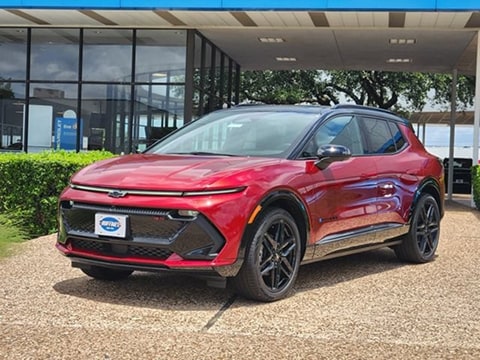
Switching to electric usually means one big question comes up first: where do I actually plug this thing in? This Chevrolet EV charging guide for Plano, TX covers home setups, public charging, and road-trip planning, whether you're running a Bolt EV around town or mapping out an Equinox EV road trip across Texas.
Still shopping? Browse our new Equinox EV inventory to see what's available now at Huffines Chevrolet Plano.
Charging Your Chevrolet EV in Plano: What to Know
Texas ranks third nationally for EV registrations, with more than 400,000 electric vehicles on the road, and Plano has roughly 290 public charging ports within about 10 miles of the city center. Every current Chevy EV, including the Silverado EV, Equinox EV, Blazer EV, and the new Bolt, supports Level 1, Level 2, and DC Fast Charging. Exact charge times vary by model and battery size, so check your Owner's Manual for specifics. Knowing how each level works helps you match the right option to your daily routine and your longer trips.
Level 1, Level 2, and DC Fast Charging Explained
Charging speed comes down to the equipment, not just the vehicle. Here's how the three levels stack up.
Level 1 Charging: Slow and Simple
Level 1 uses a standard household 120V outlet and delivers about 1.2 kW, adding roughly 3 to 4 miles of range per hour. A full charge from empty can take 50 to 60 hours, so this works best for topping up 20 to 40 miles overnight. We generally recommend Level 1 only when no other charging option is available.
Level 2 Charging: The Everyday Standard
Level 2 charging runs on 240V and is the most common setup for both home and public charging in Plano. Range added varies by model and equipment, generally between 7 and 40 miles per hour, with some equipment pushing closer to 58 miles per hour. Chevrolet offers 240V home installation through its exclusive provider, Qmerit.
DC Fast Charging: Rapid Power for Road Trips
DC Fast Charging, sometimes called Level 3, is the fastest option and forms the backbone of highway charging stations. It can add up to 100 miles of range in as little as 10 minutes on the Silverado EV, which offers available 350 kW DC Fast Charging capability. The new Bolt fast charges at up to 150 kW through its native NACS port, going from 10% to 80% in about 26 minutes, more than 2.5 times faster than the previous Bolt EV managed.
| Level 1 | Level 2 | DC Fast Charging | |
|---|---|---|---|
| Charging Speed | ~1.2 kW | Varies by equipment (240V) | Up to 350 kW (network dependent) |
| Best Use Case | Occasional overnight top-up | Daily home/public charging | Road trips, quick top-ups |
| Approx. Charge Time | 50-60 hrs from empty | Overnight (6-10 hrs typical) | As fast as 10 min for up to ~100 miles on larger-battery EVs like the Silverado EV (varies by model) |
| Typical Location | Home garage outlet | Home, workplace, retail lots | Highway corridors, dedicated stations |
| Cost to Install/Use | No install cost; standard outlet | ~$1,810 average install (Texas) | No install cost; pay-per-use only |
Setting Up Home Charging for Your Chevy EV
Most Chevy EV owners in Plano do the bulk of their charging at home, and it's usually the cheapest way to keep the battery topped up.
Choosing a Home Charger
Chevrolet and GM Energy offer a few home charging products worth comparing. The Dual-Level Cord Set supports both Level 1 and Level 2 charging, adding about 4 miles per hour on Level 1 or 23 miles per hour on Level 2. The GM PowerUp 2 adds up to 36 miles per hour and comes in both CCS1 and NACS versions.
For faster charging and more flexibility down the road, the GM Energy PowerShift Charger adds up to 44.5 miles per hour (GM's estimate based on the 2026 Cadillac LYRIQ-V; actual rate varies by vehicle), and is rated up to 19.2 kW. It's also the base unit for bidirectional Vehicle-to-Home (V2H) charging, though V2H requires a separate GM Energy Vehicle-to-Home Enablement Kit.
Installation and Texas Incentives
Installing a Level 2 home charger in Texas averages $1,810. A few incentive notes worth knowing: the Texas LDPLIP EV grant, administered by TCEQ and worth up to $2,500, stopped accepting FY26 applications as of April 2026. The federal Alternative Fuel Vehicle Refueling Property Credit (Section 30C) expired June 30, 2026. Utility rebate programs are still active, though. Oncor, CenterPoint Energy, AEP Texas, and TNMP each run rebate programs, and Oncor's Drive Forward program has offered up to $100 off select Level 2 chargers like Wallbox units through its efficiency program.
If you're living in an HOA community, Texas right-to-charge law bars HOAs from prohibiting EV charger installation in an owner's assigned parking space, though the owner covers installation and submetering costs. Renters are in a different position and will need written landlord approval before installing anything. Incentive programs and utility rebates change frequently, so confirm current details before applying. Our team can help you figure out timing and connect you with a home charger consultation through our service scheduler.
Finding Public Chargers in Plano and the DFW Area
For anyone without home charging, or just topping up during errands, public charging in Plano covers a lot of ground.
Public Charging Networks to Know
Several networks operate stations across Plano and DFW. EVgo has a station at Chase Bank, 2000 W 15th St, Plano, with six CCS1 stalls open 24 hours, offering up to 350 kW (averaging around 174 kW peak). Pricing runs $0.42 per kWh plus a $0.99 session fee on the Pay As You Go plan, with membership tiers as low as $0.29 per kWh.
ChargePoint operates a Level 2 station at AT&T Plano, 701 N Central Expy, priced at $0.26 per kWh, and a free Level 2 station with a J1772 connector at the Plano Garage, 7609 Preston Rd, a genuine no-cost option for around-town charging. There's also a Tesla Supercharger with 12 NACS ports at 7161 Bishop Rd in Plano.
Worth noting on connectors: earlier Equinox EV models use CCS1 and SAE J1772, not NACS. GM is transitioning model-by-model, and the Bolt led the way as the first Chevrolet with a native NACS port, with the 2027 Blazer EV and 2027 Equinox EV following. In the meantime, a GM NACS DC adapter lets CCS1 vehicles access Tesla Supercharger stations, and NACS-native vehicles will need a GM PowerShift AC Charging Adapter for home Level 2 charging. Check your vehicle's app for real-time compatibility before heading out.
Using the myChevrolet App and Other Tools
The myChevrolet app is the most direct way to find a nearby charging station. It tracks real-time charge status, sends plug-in reminders, and locates nearby stations where you can pay right from the app. NACS stations in particular require the app to start and pay for a session since they don't have card readers. The app's Trip Planner and Energy Bubble features visualize your available range, and Energy Pass gives you coast-to-coast charging access along with savings on DC Fast Charging. Many owners also cross-reference with ABRP or PlugShare for extra route detail.
Planning Longer Trips and Charging Routes
Route planning matters more once you leave Plano's dense charging coverage. Heading toward Fort Worth, I-20 offers EVgo and ChargePoint stations along the way, making it a solid corridor for a longer trip. Say you're planning an Equinox EV road trip from Plano toward Fort Worth: check your app's Trip Planner before leaving, note the DC Fast Charging stops along I-20, and build in a buffer since charge times vary by station load and weather.
The US-75/Central Expressway corridor through Richardson, Plano, and Allen has dense Level 2 coverage, useful for shorter regional trips or as a backup route. Whichever corridor you choose, plan around confirmed station uptime rather than assuming every listed charger is active.
What Charging Costs: Home vs. Public Rates
Home charging is almost always the cheaper option. The average Texas residential rate is about $0.15 per kWh, meaning a full charge on a 75-kWh battery from empty costs around $11. Optimized overnight utility plans can bring that down to roughly 13 to 14 cents per kWh.
Public charging costs more. Public Level 2 averages $0.30 per kWh, while public DC Fast Charging averages $0.43 per kWh, or about $32 for a 75-kWh charge, with peak pricing sometimes exceeding $0.55 per kWh. Network-specific rates vary too: Electrify America charges $0.36 per kWh for members and $0.48 for guests, while Tesla Supercharger runs $0.32 per kWh for members and $0.43 for non-members. Charging at home overnight, when possible, is still the most budget-friendly habit for daily driving.
Charging Etiquette and Battery Health Tips
Good habits at public stations and smart charging routines at home both help extend battery life and keep things running smoothly for everyone.
Sharing Stations Responsibly
-
Unplug and move your vehicle promptly once charging finishes; idle fees can reach $1.00 per minute at some networks, including the EVgo site on W 15th St and the Tesla Supercharger on Bishop Rd in Plano.
-
Avoid parking a gas-powered vehicle in an EV charging spot, sometimes called "ICEing," since it blocks access for drivers who actually need to charge.
-
Follow the network app's instructions for starting and ending sessions, especially at NACS stations that require app-based payment.
Weather Effects and Fast-Charging Frequency
Chevy EVs are engineered for cold-weather performance, and a heat pump helps with cold-weather heat recovery, but range can still dip in winter. Keep the charge port clear of ice and snow, and use Battery Prep before DC Fast Charging stops in cold weather.
In Texas heat, it helps to favor Level 2 and off-peak charging and park in shade when you can. For most Chevy EVs, including the Equinox EV, Blazer EV, and Silverado EV, keeping the battery between 20 and 80% and avoiding frequent 100% charges is the standard advice.
The Bolt is the exception, and it's an important one. Its LFP battery chemistry works differently, and Chevrolet recommends regularly charging the Bolt to 100% rather than the 80% suggested for most EVs, which keeps the range display accurate and delivers the fastest DC fast charging speeds. Occasional DC Fast Charging mixed with regular home Level 2 charging is low-risk for battery health either way.
Explore Chevrolet EVs and Ownership Support at Huffines Chevrolet Plano
Why Drivers Choose Huffines
Huffines Chevrolet Plano, located at 1001 Coit Road, carries a full lineup of electric and hybrid Chevrolets, including the Silverado EV, Equinox EV, Blazer EV, and Bolt. Our factory-trained technicians use OEM parts and offer Huffines Express Service, getting most maintenance done in 60 minutes or less. You can also pre-qualify for financing with Capital One with no impact to your credit, backed by our Low Price Guarantee.
As part of the family-owned Huffines Motor Company, serving Texas since 1924, we've spent decades building relationships with drivers across Plano and Collin County.
Ready to Get Started?
If you're ready to see what fits your driving habits, browse our new Bolt inventory or explore our full new inventory. Whether you've got questions about home charging setups, current incentives, or which Chevy EV actually fits your daily routine, contact us and our team will walk you through it.