


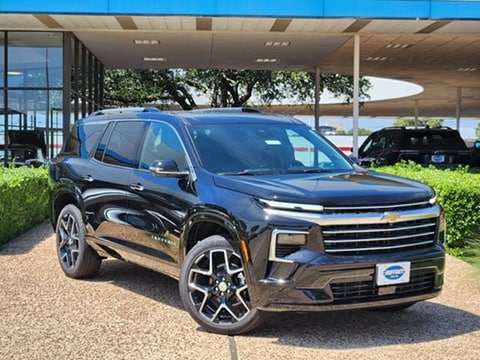
Picking a three-row SUV means weighing real trade-offs. You've got to think about how many kids fit comfortably, how much gear you can haul on a Dallas weekend trip, and whether the tech onboard makes daily driving easier or just adds another screen to fuss with. This comparison comes down to specific numbers, not vague impressions. Here's a look at the verified specs so Plano-area families can make an informed call. If you'd like to see the Traverse up close, you can browse our new Traverse inventory anytime.
2026 Chevy Traverse vs. Honda Pilot: Choosing the Right Family SUV
Both SUVs target the same buyer, someone who needs three rows, solid safety ratings, and enough flexibility for school runs and road trips. The Pilot brings a familiar V6 and Honda's reputation for dependability, while the Traverse leans into turbocharged power, more front-seat space, and a longer list of standard technology. Line up the specs side by side, though, and the Traverse pulls ahead in several categories that matter most for everyday family life in Collin County.
Interior Space, Seating Comfort, and Third-Row Usability
Front-seat comfort sets the tone for every drive, and here the Traverse has a clear edge with 44.29 inches of front legroom compared to the Pilot's 41.0 inches. That difference is noticeable on longer stretches of the Dallas North Tollway, especially for taller drivers. Second-row legroom favors the Traverse too, at 41.46 inches versus the Pilot's 40.8 inches.
Seating configurations differ as well. The Traverse seats up to eight, with second-row captain's chairs standard and a no-cost bench seat available on the LT trim for families who want the extra spot. The Z71, High Country, and RS trims stick with captain's chairs only, which creates a walk-through aisle to the third row. Chevrolet's Smart Slide feature lets those second-row seats slide and tilt forward even with a car seat still buckled in, a small detail that saves a lot of frustration during pickup lines at school.
The Pilot counters with a narrow third-row edge on paper: 32.5 inches of legroom to the Traverse's 32.13, and 39.3 inches of headroom to the Traverse's 38.27. That's about a third of an inch of legroom and roughly an inch of headroom, differences most passengers won't feel. Its stowable, fold-flat center second-row seat, standard on EX-L and higher trims, is a genuinely clever touch for occasional extra seating.
Where the Traverse holds its own is livability: the third row gets its own HVAC vents and enough usable space for adults on shorter trips, not just kids. Step forward a row and the Traverse pulls ahead again, with 42.6 inches of front headroom against the Pilot's 40.5. For families weighing daily use over spec sheets, that front- and second-row space advantage is often the deciding factor.
Cargo Capacity and Flexibility for Road Trips and Errands
Cargo space tells a more complicated story, and the measurement basis matters. Honda publishes two sets of numbers for the Pilot: standard volumes, and higher maximums that account for underfloor storage and specific seat configurations. Compared on the same basis, the Traverse leads in every category. Behind the third row, the Traverse offers 22.9 cubic feet against the Pilot's 18.6. That gap matters for daily errands and grocery runs when all three rows are occupied and you still need room for backpacks and sports gear.
Fold the third row down and the Traverse offers 56.6 cubic feet to the Pilot's 48.5. Fold everything flat and the Traverse offers 98 cubic feet against the Pilot's 87.0. The practical takeaway: the Traverse gives you more usable room in the configurations families actually drive in, and the two are closer than the headline maximums suggest. Bring your stroller, hockey bag, or cooler and check both in person.
Powertrain Performance, Towing Capability, and Fuel Economy
Under the hood, the difference is significant. The Traverse uses a 2.5L turbocharged inline-4 producing 328 hp and 326 lb-ft of torque, paired with an 8-speed automatic. The Pilot runs a 3.5L V6 rated at 285 hp and 262 lb-ft, paired with a 10-speed automatic. That's 43 more horsepower and 64 more lb-ft of torque for the Traverse, and the turbocharged engine delivers that torque low in the RPM range, which translates to more responsive acceleration in stop-and-go traffic around Plano.
Towing capacity is close between the two. Both the Traverse and the Pilot with AWD tow up to 5,000 lbs, though the Pilot's 2WD version drops to 3,500 lbs. The Traverse also carries a 1,669-lb payload rating. For fuel economy, the Traverse's EPA ratings come in at 20 city / 26 highway / 22 combined for FWD, and 20/24/21 for AWD. The Pilot's AWD TrailSport trim is rated at 20 combined (18 city / 23 highway), with FWD models reaching up to 22 combined. The numbers are close enough that fuel economy shouldn't be the deciding factor, but the Traverse's extra horsepower and torque show up in everyday driving, since a more responsive engine often means less strain during commuting and towing.
Ride Quality, Everyday Drivability, and Commuting Comfort
Both SUVs are tuned for comfort and stay quiet at highway speeds, which matters for anyone commuting into Dallas or driving the kids across Collin County. The Traverse's turbocharged engine gives it a punchier feel around town, useful when merging onto busy Plano streets or accelerating from a stoplight. The Pilot, meanwhile, received suspension and steering updates recently that give it a smoother feel in certain conditions. Picking between the two here mostly comes down to whether you value in-town responsiveness or a marginally softer ride.
Technology, Infotainment, and Driver-Assistance Features
Technology is where the Traverse separates itself most clearly. It comes standard with a 17.7-inch touchscreen, an 11-inch driver display, wireless Apple CarPlay and Android Auto, wireless charging, and a 6-speaker audio system, with Google Built-In compatibility and Bose audio available on upper trims.
Chevrolet Safety Assist comes standard across the lineup, and Super Cruise, Chevrolet's hands-free driving system, is available and comes standard on the RS and High Country trims. Super Cruise works on more than 750,000 miles of mapped roads, a feature the Pilot doesn't currently offer in any form. Higher Traverse trims also add a 360-degree camera, giving drivers a full view around the vehicle that the Pilot doesn't match.
The Pilot isn't behind on the basics. For 2026, a 12.3-inch touchscreen, Google Built-In, roof rails, and a power tailgate are now standard across the lineup, and upper trims add Bose audio. It's a meaningful upgrade over previous years, but the Traverse's combination of a larger standard screen, hands-free driving capability, and 360-degree visibility still gives it the broader technology edge for 2026.
Where the Honda Pilot May Appeal to Certain Shoppers
The Pilot has real strengths worth acknowledging. Its TrailSport trim is built with off-road driving in mind, featuring steel skid plates, 8.3 inches of ground clearance, and a TrailWatch camera system for navigating rough terrain. That clearance sits about half an inch above the Traverse Z71's 7.8 inches, which also comes with skid plates and all-terrain tires of its own.
The Pilot's Multi-View Camera System also includes front and rear washers, while the Traverse's camera washer covers the rear only. As mentioned, the Pilot's maximum folded cargo volume outpaces the Traverse's when every seat is down. And some drivers simply prefer the smooth, naturally aspirated feel of a V6 over a turbocharged four-cylinder, a legitimate personal preference rather than a performance shortfall.
On safety, both vehicles perform well. The Chevrolet Traverse and Honda Pilot are both IIHS Top Safety Pick winners in the midsize SUV category, so families won't be sacrificing crash-test performance no matter which one they choose.
Which SUV Fits Your Family Best?
It depends on how your family actually uses the vehicle week to week. If your priority is front-row comfort, low-RPM power for city driving, hands-free highway assistance, and more usable cargo space in every configuration, the Traverse's numbers back that up clearly. If you want a dedicated off-road trim, a marginally roomier third row, or simply prefer Honda's V6 layout, the Pilot has legitimate appeal too.
Choosing by Family Size and Daily Driving Habits
Families regularly hauling more than three kids, or those who often carpool with neighbors for school drop-off, will likely benefit from the Traverse's extra front and second-row legroom and its Smart Slide access to the third row. Households that tow occasionally, commute through stop-and-go Plano traffic, or want extended hands-free driving on highway trips to Austin or Houston will also find the Traverse's powertrain and Super Cruise availability useful day to day.
On the other hand, families who prioritize occasional off-pavement trips may lean toward the Pilot's TrailSport, though the Traverse Z71 covers similar ground with its own skid plates, all-terrain tires, and 7.8 inches of clearance. If you regularly fold every seat flat for furniture runs or bulk shopping trips, compare both in person. Matching the vehicle to your actual weekly routine, rather than spec sheets alone, is the best way to land on the right choice.
Explore the 2026 Chevy Traverse at Huffines Chevrolet Plano
We've been part of the Plano community as a family-owned Texas dealership since our roots trace back to 1924, and we know that choosing a three-row SUV is a decision families want to get right. The 2026 Chevy Traverse's combination of turbocharged power, additional front and second-row space, and standard technology like the 17.7-inch touchscreen and wireless charging makes it a strong option for families across Collin County and the greater Dallas area.
Schedule Your Test Drive
If the specs here have you leaning toward the Traverse, or you would like to see how it compares with our other Chevrolet SUV inventory, we invite you to stop by Huffines Chevrolet Plano and see it in person. You can also check our current Chevrolet offers before you visit.
Our team can walk you through trim differences, like the LT's no-cost bench seat option or the Super Cruise availability on RS and High Country, and help you schedule a test drive that fits your schedule. Give us a call at (888) 705-5980 or visit us at 1001 Coit Rd in Plano to compare the Traverse for yourself.